Monday, July 18, 2011

Product Review: Coco Hydro instant coconut water


Coconut juice or water -- I'm not really sure what the difference is -- is all the rage at the moment. I first tried the stuff out of curiosity last year, and my initial impression was not positive. I almost tossed the can after just a few sips! However, like coffee, beer, and most good bands, the taste grew on me. Now, I can't get enough coconut juice. Seems I'm not the only one, either: I was in Boulder at Whole Foods after a ride a few weeks back, and at least half the people eating outside selected coconut juice as their beverage of choice.

Coconut juice is marketed as a fluid replacement drink for athletes, as well as a hangover cure. I just drink it because it's delicious on hot days. In the winter coconut juice is only pretty good, but when the temperature exceeds 90 degrees, coconut juice becomes a vastly more tasty beverage. With the temperature in Denver forecast to be around 100 degrees for the rest of this week, it's prime coconut juice drinkin' season.

On hot days I could drink 3 cans of coconut juice a day, no problem. Well, except that my favorite brand, Amy & Brian's, is $2 a can. (Side note: the 16oz. can of Amy & Brian's is superior to the 12oz. can, which inexplicably has a strong hint of caramel.) As a result, coconut juice is more of an occasional treat than an every day part of my diet. While coconut juice is palatable, $6 a day for a beverage is not.

Enter Coco Hydro. I spotted it at Whole Foods today on a granola run. For $8 one gets 25 servings of cononut water powder. Just add the powder to water and, voila, homemade coconut juice. An inspection of the ingredients revealed only three: evaporated coconut juice, dextrose ("as a processing agent", whatever that means), and sea salt. Intrigued, I bought a packet. (Another aside: there are other brands that sell similar products; see, e.g., here.)


The directions recommend about a tablespoon of the powder for each cup of water. I opted for two tablespoons into about 10-12 oz of water in a pint glass, and then I topped it off with ice. The powder dissolved with just a few stirs, and unlike protein powder there was not a lot of residue stuck to the spoon or the glass. After stirring and allowing a few moments for the water-turned-juice to chill, it was time for a taste test.


The Coco Hydro coconut juice has the same great flavor as my aforementioned favorite, Amy and Brian's, although the flavor is a bit more subtle with Coco Hydro. Also, there's a bit of a soapy taste with Coco Hydro, which I'm guessing is due to the addition of sea salt. I will try adding a bit more powder next time so that the flavor has more "pop" to it, but I fear that more powder will also exacerbate the soapy issue. Overall, the soapy or salty taste isn't too bad, and my taste verdict is positive. Coco Hydro is no Amy and Brian's flavor-wise, but it's also 1/3 the price.

Amy & Brian's remains the gold standard of coconut juices. If I'm going to treat myself to coconut juice after a long ride or run on a hot day, Amy & Brian's remains my first choice. If, however, I'm going to drink coconut juice more frequently -- like I probably will this week -- Coco Hydro is tough to beat because of its substantially lower price.

I will update this review after I finish the packet. And since guerrilla marketing online is no good, I'm happy to say that I have no affiliation whatsoever with any of the companies whose products are discussed herein. I buy both Amy & Brian's and Coco Hydro at Whole Foods at regular pricing. Not that I'd object if either company wanted to send me copious amounts of their products...

UPDATE: Make sure to stir the powder in very well; don't stop when the powder has merely dissolved. After a 2:45 ride in 90+ degree weather today, I had another glass. This time all the salt was at the bottom...not tasty!
_____________________________________________________________________________________

Wavves "King of the Beach" is a good song for running intervals on a nice day:

Monday, July 4, 2011

Ironman Coeur D'Alene Race Report

PREFACE:

My goals for the race were not lofty back in the spring. All winter I was sidelined by an Achilles injury and did no running from September 2010 to March 2011, and I wasn't running at anywhere near IM volume until mid-April. That's basically 1.5 months of rehab running and then a bit under 2 months of cautious IM training. With a new home, a new job, and a dog that I can't leave in his crate all day every weekend, I struggled to get in long IM specific rides. Back in the spring, my goal was simply to enjoy training and racing and not get fixated on my result.

...And then goal-creep, the phenomenon whereby one's initially mild goals morph into ambitious, difficult to obtain expectations, set in. My running recovered surprisingly quickly, my cycling metrics were great, and I thought I had a good shot at an Age Group win or first amateur overall performance. Sure, I questioned my swimming prowess and my run durability. But I reasoned a poor swim isn't an Ironman deal-breaker, I could easily ride a low-5:00 ride, and then my natural running talent could carry me through the race.

In fact, I worried enough about my run durability, and perhaps overly confident about my cycling, that I decided to ride the first loop of the bike nice and easy to save more than usual for the run. So that was my plan: swim like normal, ride easy, run like normal.

SWIM:

The 58 degree water, give or take 2 degrees, was a non-issue for me in only a wetsuit and single swim cap. The first loop was all about positioning myself not to get too beat up, as this was the roughest swim in which I've partaken. The second loop I paid a bit more attention to finding feet, sighting, and my stroke. Surprising, I matched my IM swim PR with a 1:05.


BIKE:
I kept repeating "Ride to run, ride to run" in my head throughout the first loop of the bike. My effort was low, and I erred on the side of energy conservation at all opportunities (e.g., by not passing groups of riders, by spinning up each hill). Based on my training, I expected a 2:30-2:35 first loop. My recollection, fuzzy now several days after the race, I that my time for Loop 1 was 2:38 or so.


No problem, I'd just increase my effort to regular IM effort for lap 2, finish the ride in the low-5:00 range, just like always, and then have a solid run. However, even as I increased my effort, my second loop time was a bit worse than my first. On the positive side, the easy first loop left me feeling fantastic throughout the ride. While I normally am hurtin' by mile 80 of the bike, this race I passed the mile 80 marker thinking how great I felt and how easy the ride was coming along.


For my future records, I rode at an average of 138 bpm (whereas my past three IM average bike HRs have been 147, 147, and 151) and put out an average of 200 W (vs. 205ish W for my past three IMs). I was and still am a bit shocked that 200 W only resulted in a 5:17 ride, while just a few more watts got me 5:07 or something like that at Lake Placid.

RUN:

Now is when the goal creep came into play. After an easy ride, I was rewarded with fresh legs. With such great feeling legs, I made a game-time decision -- literally -- to go for the AG win. My guess was I'd need to run in the low 2:50s to have a shot. With my legs feeling fresh, I thought I had a good enough chance to achieve a fast marathon that the reward outweighed the risk blowing up.

My plan was to push really hard the first loop of the run in hopes of reaching the front of the AG race. If I could do that, I'd hope to hold on and allow my natural running ability and competitiveness to carry me to the finish line. The biggest question mark in my head was whether my lightly trained running legs would withstand 26.2 hard miles.

Instead of capping my HR at 160 bpm, like my normal and prudent plan, I went by feel and tried to run as fast as I could without feeling like I was straining. My HR was in the mid-160s and my PE was surprisingly low as I ran the first 13.1 miles right around 6:30/mile. The pace felt easy enough that a 2:50 run seemed possible, even approaching the halfway point of the run.

I continued that pace for a few more miles after the turn-around, and then had to start pushing really hard to hold sub 7:00/mile as I went reached the run course hills around miles 16-17. Climbing the steepest hill on the course shortly before the turnaround zapped my legs of their remaining energy with around 8 miles to go and my pace dropped to around 8:00/mile at its best. Hello, death march.


Fortunately, my death march pace isn't too bad and I was able to finish the run in a respectable 3:07. (Side note: I am extremely impressed by the number of athletes that ran below 3:10 -- the results are littered with low 3:00 runs!) My quads were so shot after the run that in the med tent after the race I could not move my legs. I had to ask volunteers to help my change my legs' position while resting on a recliner. My legs gave all they could during the race.


SUMMARY:
I wonder how my race would have gone if I'd held typical IM effort on the bike. I lacked confidence in my ability to hold 220 W for the ride and still run well, especially coming off so few run miles in training. But, it is also my experience that I don't need to work that hard to have a good AG bike split. So in retrospect I think my race plan on the bike was good. I'm just surprised at the result.

I also don't regret my suicidal run pacing. Sure, it didn't go as perfect as I'd hoped (knowing a 2:50 run was a long-shot). But despite my hard run, I still podiumed, and more importantly I didn't hold anything back. Winning my AG will require taking risks during races, and running with a HR in the mid 160s was a risk I knowingly and willingly took.

FACTS:

-- 9:37, which I think is my second fastest time, although almost 20 minutes of my PR.
-- 4th in my AG, and 4th straight IM podium.
-- 30th overall, which is my second worst overall placing in my 6 IMs. This despite my second fastest time...

HAPPY ANNIVERSARY:

Ironman CdA fell on Stacey and my 1st anniversary. Yay, us! (As opposed to the typical "yay, me!" theme of the blog.) What adventure can we do next year?

CONGRATULATIONS:

Not only did the race fall on our anniversary, but my brother Conor and his wife Teresa also competed in the race. Congratulations to all of you. Special congrats to Stacey for shattering her goal by 20 minutes!

Saturday, June 25, 2011

Why Ironman? + Photo Dump

At some point while racing an Ironman, one thought goes through every racer's head: "Why I am doing this?" For me, the answer is because I enjoy the training process, but also because race day is a chance to test myself.

Our modern lives are arranged around being comfortable. Physical exertion is intentionally minimized, our climate is precisely controlled, every pain should have an instant cure, and any diet must include chocolate flavored (fill in the blank) so we can have our cake and eat it too.

With discomfort banished, we now demand instant satisfaction, instant cures from all ailments, and instant food. "Want to lose 20 pounds? With our special program you can lose all the weight you want without exercising and without changing your eating!" People buy that stuff, and not just once but repeatedly. Sacrifice is discouraged.

Tomorrow will not be an easy or comfortable day. Tomorrow I will not be thinking about work or bills or home decorating. By 2:00 PM tomorrow I will be thinking about my instant needs, not wants. Ironman is one of the few times when that change occurs -- when real needs fully occupy one's mind. The satisfaction I get from my race tomorrow will be directly related to the work I've put in and the sacrifices I've made.

Hopefully this post doesn't come across as a crazy rant! My guess is that if you've done a few Ironmans you understand what I mean.
_____________________________________________________________________________________

My family and I drove from Denver to Coeur D'Alene earlier this week, opting for the scenic route. We passed through both Grand Teton National Park and Yellowstone National Park, but didn't have the time to get too far away from our cars. Nonetheless, the scenery was spectacular and I plan on considering a circum-Yellowstone cycling trip next summer. Random photos below:


Friday, June 17, 2011

Ironman Fears + Solutions

Chris McCormack's new book, I'm Here to Win, is the inspiration for this post. While I don't love the book, it had enough useful information that I'd recommend it to any fan of the sport.

One point McCormack makes is that the goal of training is to perform well in races, not to accumulate training hours or push one's self to the brink. Race results, not training logs, define successful training. Triathletes have a tendency to over train, McCormack writes, because they often lack confidence in their ability to race well. Athletes want to bolster their confidence with huge training volumes, or by cramming in one more tough workout before each race just to make sure they've still got it.

I'm not immune to feeling a lack of confidence, especially this year. My training volume in preparation for CdA has not be as great as the past two years, and I don't have many recent race results on which to fall back. However, I have good reason to be confident for Ironman Coeur D'Alene.

Despite a lack of 5- and 6-hour rides, every test workout I've undertaken recently has shown great results. Last week I did a ride with 3 hours at under IM effort and averaged 22.2 mph with an average HR of 131 bpm. (I'll keep my power numbers secret for that one!) The route was two loops outside of Boulder and was nearly as hilly as CdA. That speed is faster than any IM bike split I've done and still came in 15 bpm lower than I can hold for an IM.

Just today I did a 3 hour ride with 1 hour at IM effort on Lefthand Canyon from Boulder to Ward and averaged 230 W at 147 bpm. For comparison's sake, 147 bpm has been my average HR for my last two IMs, while I've only averaged a bit of 200 W for each of those races.

These metrics are much more directly related to race performance than the number of hours of training I log. So, even if my volume isn't up to previous levels, my actual performances exceed benchmark workouts in past IM build-ups. In other words, I've got the fitness I need to perform well. I don't need to get more fit by squeezing in another training effort. Every time I have the urge to squeeze in one more workout from now until June 26, I will remind myself that the workout will likely do more harm than good.

Another insightful section of the book explains one of McCormack's mental strategies for race day. Defeat in an Ironman, he explains, occurs when one convinces one's self that quitting or slowing down is okay. McCormack developed a strategy that he uses to fend off the negative thoughts that all IM racers get.

The first step McCormack takes is to predict all the negative thoughts that might go through his head during the races, essentially creating a list of fears. Then, he comes up with a solution to each fear. This way, if a negative thought creeps into McCormack's head, he can quickly dispel it with his preconceived solution. This strategy helps him avoid rationalizing slowing down or quitting. A great example of this strategy is how McCormack overcomes the desire to ease up when the inevitable pain at the end of an Ironman sets in: he simply reminds himself that he's pushed through the pain before and come out fine. The pain is just temporary, he tells himself, and it actually a sign of a successful race.

I like the McCormack's strategy, so I thought I'd create my own list of fears and write my own solution here. This should help me quickly remember the solution and maintain a positive attitude throughout my race.

Fear: I swim slower than 1:05-1:08.
Solution: Remind myself that my fastest Ironman began with a 1:12 swim. I can have a slow swim and still be in contention to win my AG and be the fastest amateur. Plus, my cycling has been strong lately and I can make up a lot of time on the bike.

Fear: I get a flat tire or have a mechanical issue on the bike.
Solution: I've changed plenty of tires and can do so very quickly. Losing three or four minutes won't affect my overall position much. Again, my cycling has been very strong so I could ride several minutes faster than in the past, negating any time lost during a flat change.

Fear: My bike time isn't fast.
Solution: At Louisville two years ago, I had a horrible swim and what at the time I thought was a poor ride. I saved the race with an amazing run. I can do that again. I've likely run 15 minutes faster than anyone else in my AG, so I can make up a lot of time at the end of the race.

Fear: I feel exhausted at the end of the bike and worry that I went too hard.
Solution: It's a 112 mile ride, I'm supposed to feel tired at the end of it! I've run well under 3 hours in the past on tired legs; there's no reason I can't do it again. Even if my run gets off to a bad start, I can still run 3:20 on my worst days. The key is to keep moving onward and to know that I can have a solid run under any conditions. A good ride and even a 3:20 run will put me in a position to place high in my AG.

Fear: Liquid pools in my stomach during the run.
Solution: Take in some sodium and ease off the calories. Drop the pace for a moment. The feeling will pass. Once it passes, I'm right back in the game. I've seen my HR jump 15 bpm (a good thing) after taking in sodium to relieve pooling liquid in my stomach. Almost everyone goes through a bad patch in an Ironman. Those that do well stick it out.

Fear: I'm in pain.
Solution: Enjoy it! The pain and the challenge of overcoming it are why I sign up for Ironmans in the first place. It's not going to hurt me. Hell, if I don't hurt, I better speed up!

Wednesday, June 8, 2011

Sunrise Triathlon

This was my first race since IM Louisville 9 months ago. I was curious to see how rusty I'd be and how pushing myself would feel.


Swim:
Blah. A cold and uneventful 25 minutes. I was far enough back from the good swimmers that I passed a Team Timex lady a few miles into the bike, which wouldn't be all that bad but for the fact that the women's wave started several minutes after the guys'.

Bike:
My cycling metrics have been good lately, so I was optimistic about putting up a good time "in the field". I know the course pretty well, and I know that the first few miles are the toughest because they're gradually uphill. My plan was to go really, really hard until the first downhill section on Hwy 36 (about 10-15 minutes into the ride), then push every uphill and flat section really hard until Nelson. At Nelson, the course is pretty much flat or downhill until returning back to the reservoir. I expected to be going ~26-27 mph or faster most of the way after turning onto Nelson, and therefore I figured pushing the effort there offers marginal benefits.

My plan seemed to go well, as I passed everyone in sight on the bike. The course offers a handful of vantage points that allow racers to see far up the road, and the course ahead of me looked clear. I was optimistic that there'd be no bikes in T2 when I returned, but unfortunately 4-5 guys beat me to the run.

My strategy is evident in the graph below, as my HR is highest initially, low along the Nelson decent, and then back up to normal Olympic effort around 75th Ave.

Normalized power appears to be ~270 W. Average HR was 158 bpm. Speed was 25.5 mph, which is a bit slower than expected.

Run:
The big question mark. I took a lot of time off running due to a still not completely healed Achilles injury. Would my speed still be there? Well, the good news is that I had the fastest run split at 5:54/mile at an average HR of 167 bpm. The bad news is that my run isn't good enough to overcome my swim.

Takeaways:
3rd overall, 1st in 25-29 AG
Positives -- I am fit heading into CdA. My running is strong and near or back to my former level. My bike is also a strength.

Negatives -- My swim prevents me from actually "racing" anyone. It'd be more accurate to say I do an individual time trial every race, and then see where I end up. If I came out of the water near the front, I could gauge how hard I need to ride based on the power needed to stay at the front of the race. I have no doubt in my mind that I could have rode harder. Yes, a harder ride may have slowed my run, but if I started out with a good swim at least I'd be in contention. Better to die trying, as they say.

I'm considering basing my entire training and racing schedule next year around improving my swim. This idea deserves a post unto itself.

Finally, congrats to the winner, Drew Scott. He smoked me by 7 minutes. I had to look back at last year's 70.3 results and noticed I beat him by 20 minutes. (I remember his name from that race because at the awards ceremony the announcer made a point to mention Drew's father, Dave Scott, who did a race or two in his day.). He's a young guy but appears to have taken a giant leap forward.

Saturday, June 4, 2011

Benchmarks

I'll start off with some pictures of my typical long run in Denver. It's a great running city, and I can pass through and around several large parks in the span of one long run. (I really should stop to shoot to avoid blur...)


The build to IM CdA is almost done. I'm taking a few days easy after an olympic race today -- report coming tomorrow hopefully -- then going pretty hard next weekend before commencing with a two week taper.

Here are a few benchmark workouts I've done over the past month:
-- Benchmark swims have been based solely on time and perceived exertion. I focused on very IM specific sets, such as 4 x 12 minutes with the evens at IM effort and the odds with paddles and a pull buoy. My goal here isn't so much to improve my swim time as it is to ensure I exit the swim feeling prepared for a solid ride and run.
-- Long ride 1: Warm-up, 2:45 at a bit below IM effort (21.6 mph average sans aero-gear over terrain a bit more hilly than CdA), and then 45 minutes of hill repeats up Lee Hill.
-- Long ride 2: A bit over 4 hours with 2:30 at a bit below IM pace on mostly flat terrain. In the 2:30 I covered 56 miles, again sans aero gear.
-- Long ride 3: The plan was 2 times up to Ward from 36 in Boulder, but I cut the ride short due to severe wind. Still, it was a noteworthy ride because I averaged a very easy 215 W at 135 bpm in the aero bars. Last year I did the same climb with a HR several bpm higher.
-- Long run 1: 45 minutes in the morning, 1:30 in the evening. The evening run included a warm-up, 3 times through 2 miles at IM effort + 1 mile easy. IM effort miles were in the 6:35 -- 6:50 range.
-- Long run 2: 9 miles at IM pace based solely on PE. Average pace was right around 6:50. I followed that up with a long steady hill climb and then a cool down for a total of 1:50 running.

So, things are coming along. Before the race I will post a detailed race plan, along with my fears for the race and solutions for those fears.

This week's song is a great listen on a sunny run.

(Jonsi, FYI, is the singer from Sigur Ros.)

Monday, April 25, 2011

More Inconsistent Training

This past month has been busy. Stacey and I went to Saratoga Springs for a wedding a few weekends ago, then I had one weekend of mediocre training, then the past two weekends have been occupied with moving out of our apartment and into a house. That's mostly good stuff, but it tends to really reduce my training load. I'm a big proponent of at least one long day a week during an IM build, yet the most volume I've done on a day is 5 hours, and I haven't done one of those days in a few weeks.

Still, my metrics aren't bad. I set a new PR in a 200m free while in New York. I put an 11-23 or -25 cassette on my new bike, which allowed me to push 265-270 W during my favorite big gear trainer ride (lots of 5 minute intervals at 60 rpm and 150-155 bpm). My long run is up to 1:40, and yesterday my run included three miles at ~6:40/mile at right around IM effort.

Weight is an important number for IM racing, too. Right now I'm around 160 lbs, so that's all well and good. Still, starting tomorrow (not to sound like a quitting smoker...) I am going to adopt a "diet" inspired from a post on Slowtwitch that greatly limits or eliminates eating after 7:30 per night. Running is especially weight sensitive, and given my recent injury I need all the running help I can get. 155 lbs at CdA?

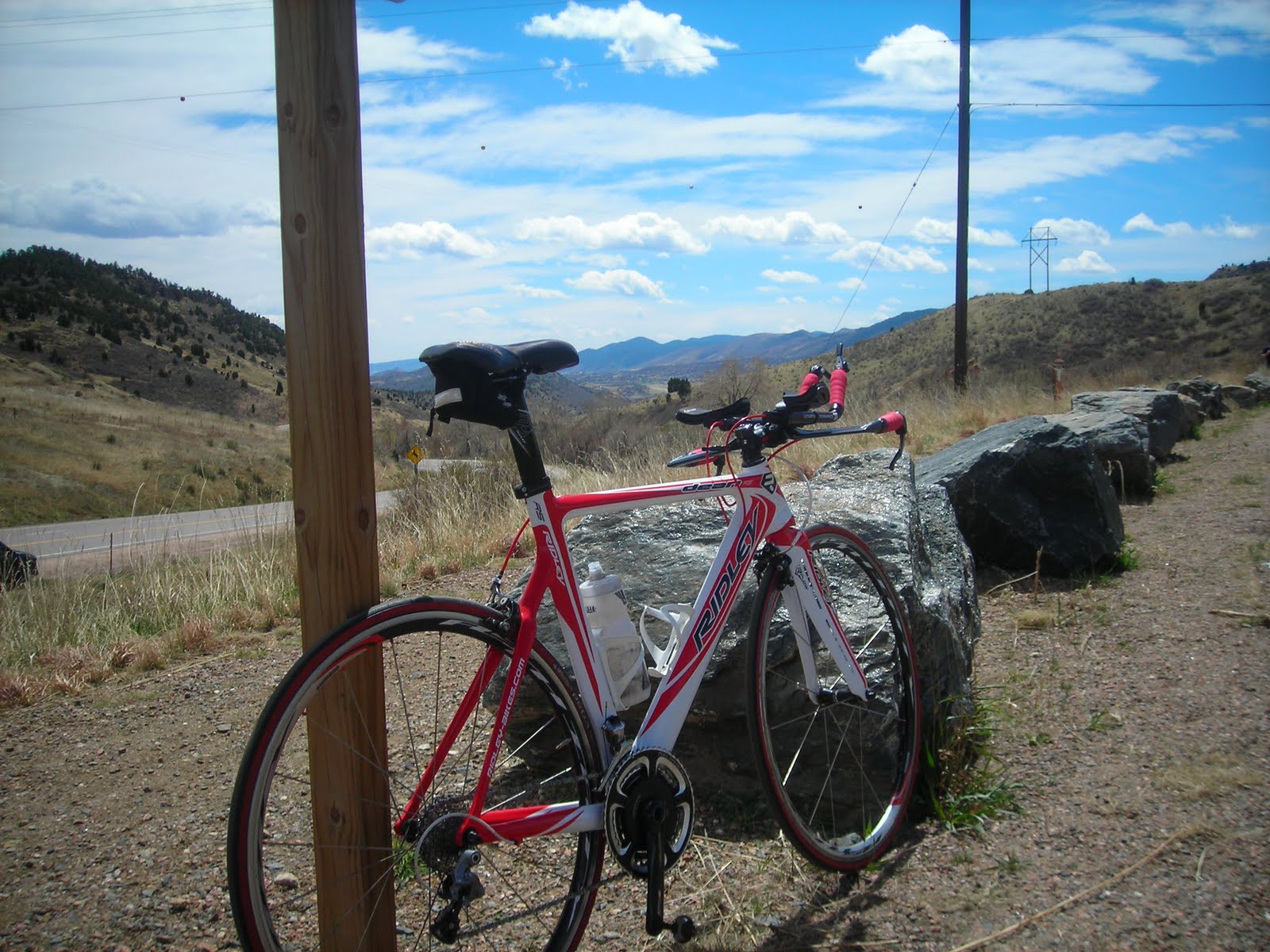
Finally, I should post some recent ride photos. First up, here's my new ride, a Ridley Dean RS, right near I-70 between Golden and Morrison:


Here are some pictures of a climb from Boulder to Peak-to-Peak. The old lookin' town is Gold Hill, which is a 150 or so year old yet still occupied mining town circa 8,000 feet. Evidence of last summer's Gold Hill Fire is also visible in many of the pictures. There were loads of houses burnt to the ground with only their chimneys remaining. (I tried to capture one such chimney with minimal luck in the last photo.) Around 8,500 feet, it became really, really windy and began snowing. I struggled up under-dressed to 9,500 feet over some very rough roads afraid I was going to get lost or stranded. Overall, a great ride.


Finally, this week's song: a metal and flamenco influenced acoustic duo from Mexico City whose recent album topped the charts in Ireland.

Looking up this video, I noticed these two are playing in Boulder in two days. Hmmm...Anyhow, it's good stuff to listen to while running fast.